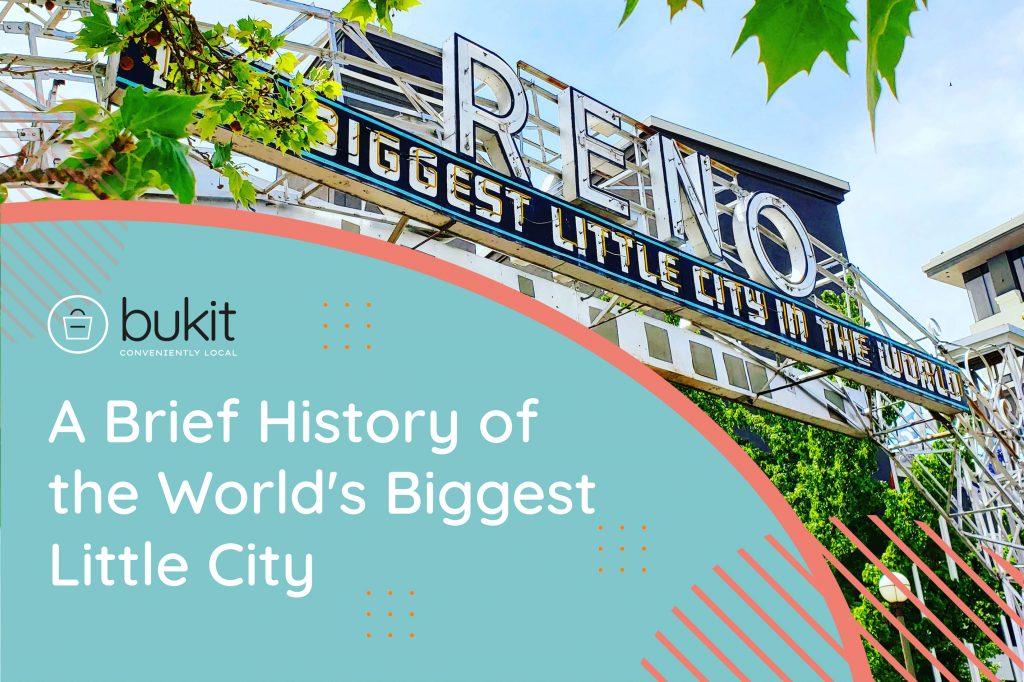
A Brief History of the World’s Biggest Little City
Reno, known as “The Biggest Little City in the World,” is a city in the Northwest United States, in Nevada, along the Nevada-California border.
Reno may be most renowned for its casinos, but there’s so much more to this little town. Despite its reputation and an economy that depends on the tourist industry, there is, and always has been, an everyday Reno, a place where regular people live and work, go to school, shop, play, and socialize.
Its sprawling mountain range holds a rich history filled with tales of humble beginnings, the silver rush, and a mining boom that contributed to creating the cosmopolitan Reno that we know and love today.
In this blog, we will submerge ourselves in the interesting history of the world’s biggest little town.
Starting Out
Native Americans camped, hunted, and fished in the Lake Tahoe Basin long before non-natives discovered it in 1844. Lake Tahoe and the surrounding 10,000 square miles were once home to the Washoe Indians, and Washoe tradition suggests that Lake Tahoe has been their homeland for as long as 9,000 years.
Reno’s humble start began on the Truckee River, which was considered the preferred crossing point for travelers en route to the California gold rush of the late 1840s and early 1850s. When the discovery of silver in Virginia City was made public in the spring of 1859, the city saw an influx of quick-money seekers flocking to Virginia City to get their hands on the riches. A vast majority of these men also rushed to California in search of gold a decade prior. However, there was one significant difference. While Gold Rush residents had plenty to eat thanks to California’s agricultural bounty, Comstock Lode prospectors did not. Except for the lightly populated Truckee Meadows, almost all of western Utah Territory was poor farming and grazing land. Farmers in northeastern California discovered The Comstock to be a ready market for their produce and meat. Bill Fuller (an early, enterprising settler of the region) became very familiar with the routes from the ranch to Virginia City because his mother, Frances Fuller’s farm was one of those Honey Lake Valley Comstock suppliers.
Those looking to deliver supplies from California to The Comstock discovered that they didn’t have many options to cross the Truckee River safely. The river was swiftly flowing, and the bottom was littered with massive boulders, making it nearly impossible to drive wagons and herds across. In order to make the most of the traffic across the river, two stations along the river had been established in 1859, complete with toll bridges, small inns, and taverns. These crossings can be found today at Verdi and Stone & Gates Crossing in today’s east Sparks, respectively. Stone & Gates would build its own toll bridge by the end of 1860, but its location in the Truckee Meadows was in a sink, so it was swampy and difficult to cross for much of the year. Other stations on the river existed, but they were further south and/or east, making them inconvenient for California-to-Virginia City traffic.
Founder of the Biggest Little Town
Before Reno, the town was called Lake’s Crossing after Myron Lake, an entrepreneur and hotel keeper. Lake purchased a wooden bridge, tavern, and inn situated on the banks of the Truckee River from Charles “Bill” Fuller. There isn’t much known about Fuller other than the fact that he spent years trying to monetize the supply wagons that occasionally passed through the area on their way to Virginia City. For unknown reasons, Fuller was never successful in this endeavor, and eventually, he gave up and sold the land to Myron Lake. Where Fuller failed, Lake found success in building a toll bridge franchise that operated for ten years. After he built his fortune from his toll bridge, he encouraged the formation of a townsite on his land.
By January 1863, the Central Pacific Railroad (CPRR) had begun laying tracks east of Sacramento, California, eventually joining the Union Pacific Railroad at Promontory, Utah, to form the First Transcontinental Railroad. Lake gave the CPRR land in exchange for a promise to build a depot at Lake’s Crossing. Washoe County was merged with Roop County in 1864, and Lake’s Crossing became the county’s largest town. Despite the fact that Charles Fuller arrived in Reno well before Lake did, Myron Lake is credited as the founder and first resident of Reno. Reno officially became a town on May 9, 1868, after the railroad station was built.
Major General Jesse Lee Reno, a Union officer killed in the Civil War at the Battle of South Mountain, was named inspiration for the community by CPRR construction superintendent Charles Crocker.
Moving Up
Transportation has always been an important theme in the history of Reno and Truckee Meadows. People and goods have been transported into and through the region via emigrant trails, stage roads, the Pony Express, highways, commercial aviation, and the railroad. The construction of the transcontinental railroad through the area in 1868 was the most significant event in Reno’s sometimes sputtering development.
The Virginia and Truckee Railroad’s extension to Reno in 1872 boosted the new city’s economy. Reno grew and prospered as a business and agricultural center over the next few decades, eventually becoming the main settlement on the transcontinental railroad between Sacramento and Salt Lake City. As the mining boom faded in the early twentieth century, Nevada’s political and business centers shifted to non-mining communities, particularly Reno and Las Vegas. Nevada is still the world’s third-largest gold producer, trailing only South Africa and Australia. In 2005, the state produced 6.9% of the world’s supply.
Water requirements grew in tandem with the growth of Virginia City and its surrounding cities. The historic Virginia Gold Hill Water System was built in 1873 to meet the demands of the nearly 30,000 people who lived in the boom towns by raising the dam at Marlette Lake in North Lake Tahoe, creating Hobart Reservoir, constructing a number of flumes and pipelines to transport the water, and inventing an ingenious inverted siphon to transport the water through Washoe Valley.
In 1900, there was a massive mining boom in southwest Nevada which gave the state an economic boost. Reno reaped the benefits of the new boom in two ways: economically, and through the arrival of millionaire George Wingfield who made his fortune in Goldfield. Wingfield turned Reno into his home where he ran and expanded his empire, which included banking, hotels, mining, politics, ranching, and hotels. The arrival of the twentieth century also began to alter the spirit of the town, which had a population of around 4,000 people at the time. Reno was incorporated as a city in 1903. (after an earlier unsuccessful attempt in 1897).
The University of Nevada was established as a land-grant university in 1874. The construction of the main campus followed suit, and was completed in 1885, on a rise of land overlooking Reno from the north. The university has played a crucial role in the identity of the young town and largely contributed to Reno’s cultural center from its inception. This was reflected in Reno’s nickname, “Biggest Little City in the World,” which arose as a result of the city’s relatively small size and wide range of cosmopolitan amenities.
Reno became a popular destination for quick divorces in the early 1900s, and Nevada legalized gambling in 1931. Reno was a pioneer in developing the destination hotel/casino gaming model, which has since been replicated around the world. Virginia Street, the main north/south thoroughfare through downtown, has evolved into a commercial hub of mid-scale, locally-owned destination hotels/casinos and retail stores. The transcontinental Lincoln Highway (now 4th Street) ran through the heart of downtown, and many motor lodges sprouted up on either side of the Virginia Street core to support the city’s brisk postwar automobile tourism. Tourism, as well as the gaming and entertainment industries, were the backbone of Reno’s economy for the majority of the twentieth century.
Reno’s location and the development of the expansive network of railroads made it an ideal location for a city, with rail connections to Salt Lake City and San Francisco. The railroad was the town’s lifeblood, providing passengers and commerce while ensuring the town’s independence from other industries that were more boom and bust at the time, as was much of the state.
While Reno started out as a humble toll bridge to assist people attempting to travel across the Truckee River, today the big little city has world-renowned casinos, a wealth of clothing stores and boutiques, as well as outdoor activities and family-friendly destinations. One thing is true, you’ll never get bored of modern-day Reno, since there are activities that will suit the entire family.
If you ever feel like escaping into the past, you can step into the shoes of Reno’s original residents by exploring the historical spots that are scattered throughout Reno.
Come and explore the “Biggest Little City in the World.” And while you’re in town, shop bukit for the most convenient shopping experience in Nevada!